Robot Mower Setup: Base Station, Antenna and Mapping
Robot mower setup guidelines: where the charging station and RTK antenna go, clearances, power and GFCI, boundary wire distances and first mapping.

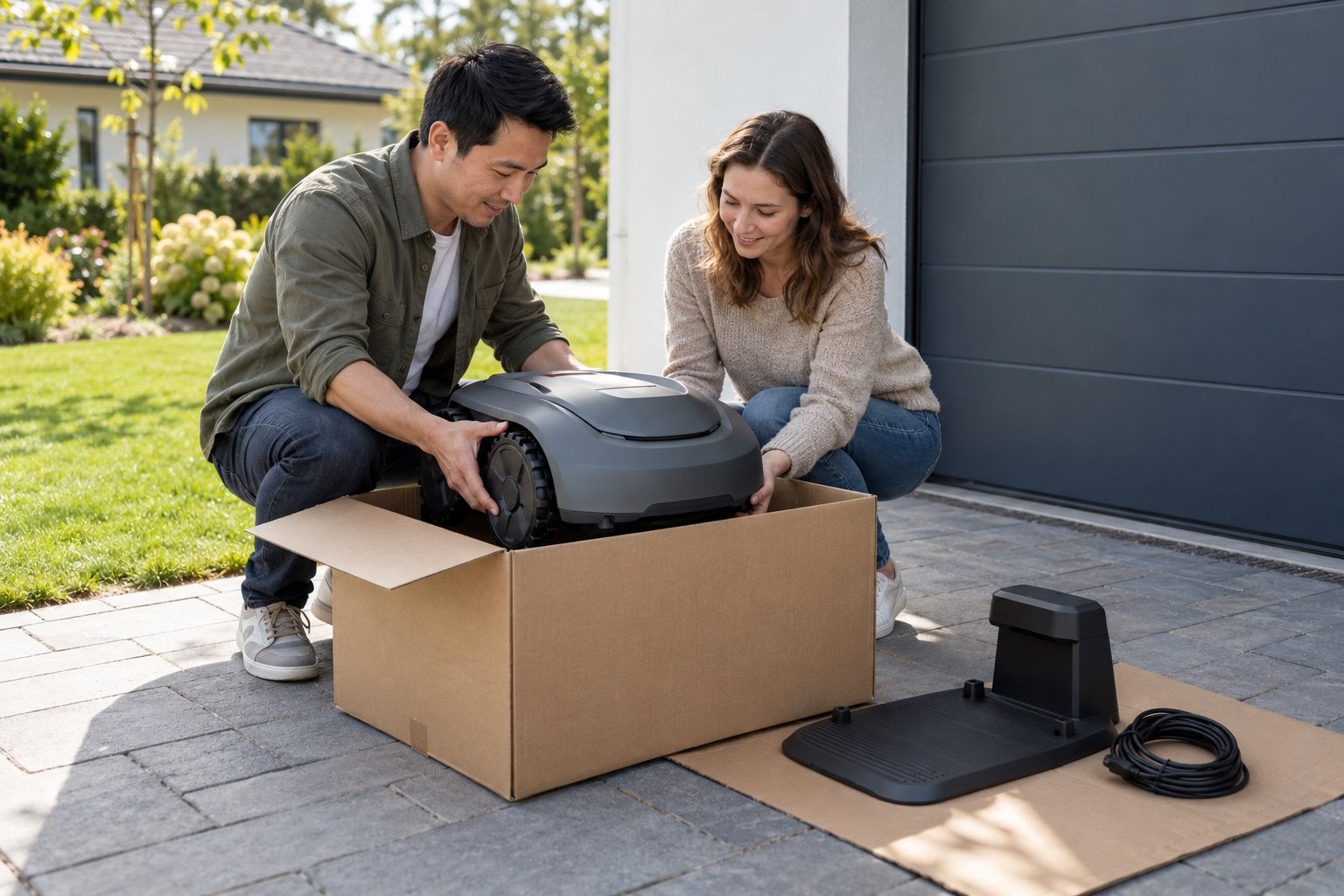
Put the charging station on level ground near a weatherproof GFCI outlet, with about 2 m (7 ft) free in front, and keep an RTK antenna more than 2 m from houses, trees and walls under open sky. Mow the lawn short before the first run and map or lay the boundary at the distances the manual gives. Here are those guidelines from the Husqvarna, Gardena, Navimow and Mammotion manuals, side by side.
Affiliate disclosureAs an Amazon Associate we earn from qualifying purchases. Commissions never change our ratings.
Where the charging station goes
- Level and firm: Husqvarna, Navimow and Mammotion all say level ground, not a slope; Mammotion adds that the base plate must not bend or tilt.
- Room to dock: 2 m (7 ft) free in front and 1.5 m (5 ft) to each side of the center for the Husqvarna 520/550; a 1 × 1.5 m (3 × 5 ft) clear area for the LUBA 2.
- Low part of the lawn and in the shade: Husqvarna recommends both.
- Away from water: Navimow says stay away from sprinkler heads and fountains, and keep the running mower at least 1 m (3 ft) from sprinkler heads.
- Not in a corner: Mammotion advises against an L-shaped corner of the house or a narrow path between two structures.
Power: outlet, cable length and GFCI
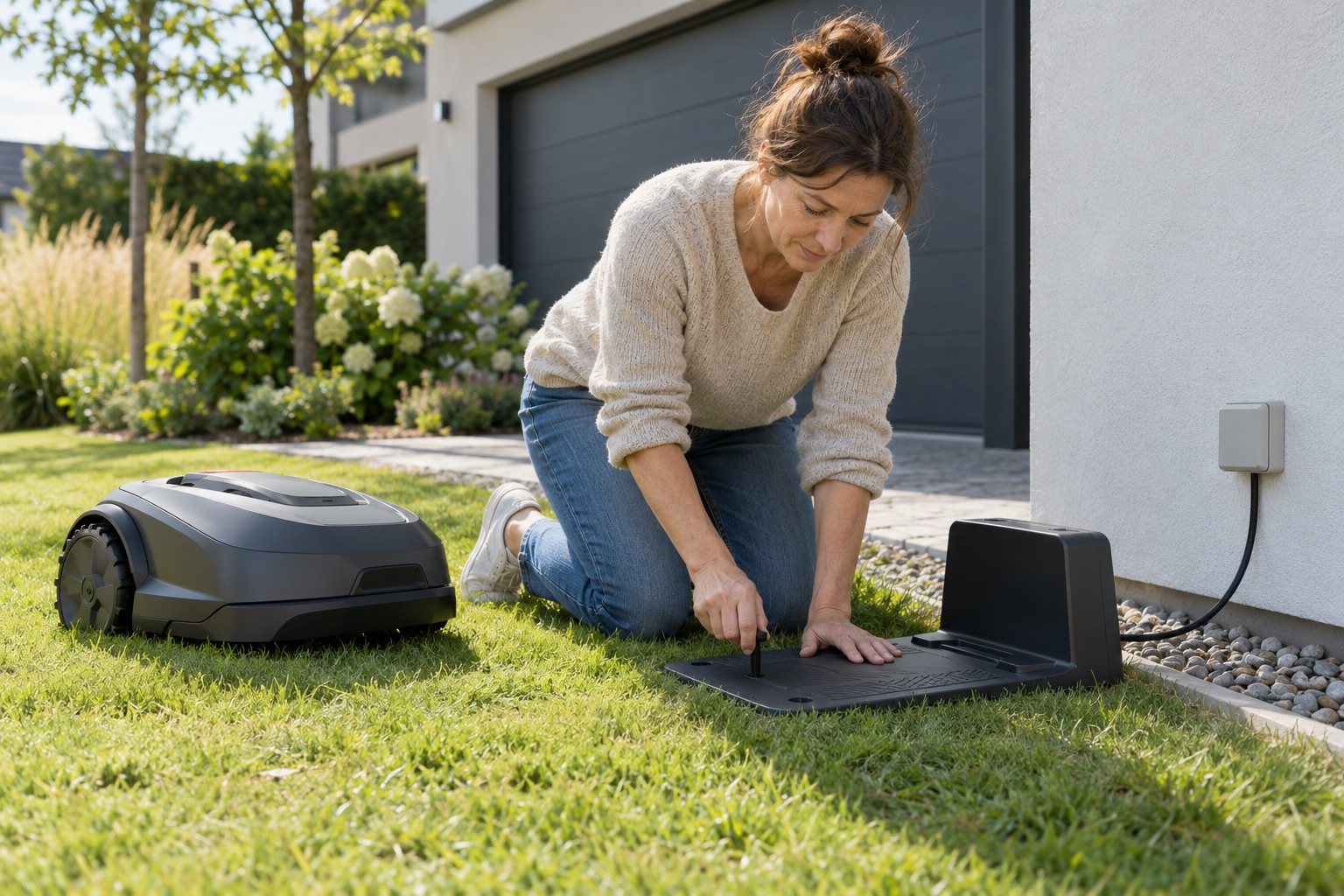
The outlet is the fixed point, so check cable lengths first. The low-voltage cable from power supply to station is 10 m (33 ft) on the Husqvarna Automower 520/550 and 3 m (10 ft) on the Gardena SILENO minimo; Navimow puts 10 m (33 ft) extension cables in the box, and its antenna cable can be extended to 30 m (98 ft) in total. Husqvarna says never to cut, extend or coil its low-voltage cable, to keep the power supply under a roof, off the ground and ventilated, and to use a residual-current device; in the US that means a covered, weatherproof Class A GFCI receptacle. Worx recommends a GFCI outlet as well.
RTK antenna: sky view first
Navimow’s rules are the clearest: more than 2 m (6.6 ft) from houses, trees and walls, nothing blocking the signal within 2 m, nothing overhead, and if all sides cannot stay open, keep the southern sky clear. Mammotion recommends mounting its reference station on an unobstructed wall or roof when the lawn is L-shaped, and never under a tree. Both brands offer extension kits for a wall or roof mount. Navimow’s app has an antenna location finder and a satellite signal analyzer; use them before you drill. One rule that saves an afternoon: Navimow says that once the antenna moves, the existing map can no longer be used and you map again.

Boundary wire distances
| Edge type | Husqvarna 520/550 | Gardena SILENO minimo | Worx Landroid (US) |
|---|---|---|---|
| Wall, fence or bed edge above 5 cm / 2 in | 35 cm (14 in) | 35 cm (above 3.5 cm) | 10 in from a step |
| Low obstacle 1–5 cm | 30 cm (12 in) | 30 cm (1–3.5 cm) | – |
| Flush path, under 1 cm | 10 cm (4 in) | 10 cm (4 in) | 4 in |
| Pool or water | protective wall of 15 cm (6 in) | barrier of 15 cm | at least 12 in |
Pegs go at most 100 cm (40 in) apart and a buried wire 1 to 20 cm (0.4 to 8 in) deep, per Gardena. Gardena also warns that cutting very low right after installation can nick the insulation, a fault that may only show weeks later, so start at a higher cutting height.
Before the first run
- Mow the lawn conventionally first: to 6 cm (about 2.4 in) or less for Navimow, 10 cm (4 in) or less for Husqvarna.
- Fill holes, pick up stones, toys, hoses and fallen fruit.
- Charge the mower fully before mapping.
- Walk next to the mower when you map: Navimow asks you to stay within 6 m (19.7 ft) during assisted mapping.
- Set a PIN and turn on the anti-theft alarm if the model has one.
Husqvarna notes the mower may sound louder for the first weeks, until the grass is at an even height.
Our rated picks and the parts that come with them
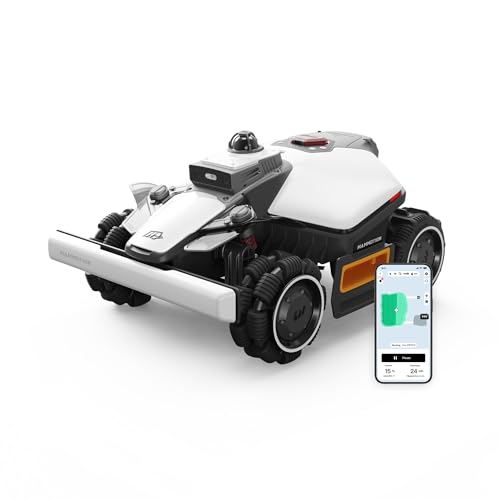
For an RTK model, check what is in the box: an antenna, extension cables, a wall mount or not. Mammotion LUBA 2 AWD 3000X (9.3/10) uses a reference station you place yourself; Segway Navimow i105N (8/10) connects its GNSS antenna to the charging station. If you would rather place nothing but the station, Mammotion LUBA mini 2 AWD 1500H (8.1/10) navigates with LiDAR and vision. Extra cables and mounts are in our accessories collection, for example Segway Navimow Antenna Extension Kit and Berfea Charging Station Cable 10 m.
Our rated picks
Short on time? Start with these three from our best robot lawn mowers in 2026 ranking.


Product images: Amazon listings
Frequently asked questions
Where is the best place to put a robot mower base station?
On level ground in the lower part of the lawn, in shade, near a GFCI outlet, with about 7 ft free in front and 5 ft to the sides. For RTK, the antenna also needs open sky more than 6.6 ft from walls and trees.
Can the charging station be outside the lawn?
Usually yes, on a hard surface at lawn level or with a short wired or mapped path to it; Worx allows a walkway at the same height as the lawn. Check the docking rules in your manual.
Does a robot mower need a GFCI outlet?
Husqvarna requires a residual-current device, which outdoors in the US means a covered Class A GFCI receptacle, and Worx recommends one too.
How far from the edge should the boundary wire be?
Typically 35 cm (14 in) from a wall or bed edge, 30 cm from a low obstacle and 10 cm (4 in) from a flush path, per Husqvarna and Gardena.
Sources
- Husqvarna — Automower 520/550 operator's manual (PDF) (consulted Nov 2026)
- Gardena — SILENO minimo operator’s manual, 2025 (PDF) (consulted Nov 2026)
- Segway Navimow (copy hosted by EU9) — Navimow i-series user manual, i105E/i108E (PDF) (consulted Nov 2026)
- Mammotion (copy hosted by Greentools) — LUBA 2 AWD series user manual V5.0 (PDF) (consulted Nov 2026)
- Worx — Landroid owner’s manual WR165/WR147/WR155 (PDF) (consulted Nov 2026)
Products mentioned
- Our review: Mammotion LUBA 2 AWD 3000X (exact Amazon listing)
- Score and specs: Segway Navimow i105N (exact Amazon listing)
- Rating and specs: Mammotion LUBA mini 2 AWD 1500H (exact Amazon listing)
- Our review: Segway Navimow Antenna Extension Kit (exact Amazon listing)
- Our review: Berfea Charging Station Cable 10 m (exact Amazon listing)