
Elliot Navarro, Navigation & setup writer
I cover the part of robot mowing that decides whether the thing works in your yard at all: how it knows where the lawn ends. That means boundary wire, RTK satellite positioning, camera vision and LiDAR, and it means slopes and base stations too.
The work is mostly reading. I go through installation guides, antenna requirements, app setup pages and the fine print on slope ratings, then I put mowers next to each other so the differences show. A lot of my time goes into converting numbers. One brand lists slope in percent, another in degrees, and 45% is about 24 degrees, not 45.
Owner reviews matter a lot in my area, because navigation problems are where people get specific. Lost signal under a big oak, a mower that wanders near the house wall, a boundary wire cut by an edger. When the same story turns up across many reviews, it goes into the guide.
What I want you to take away is simple: exactly what each listing and manual asks of your garden, before you buy rather than after.
Areas of expertise
- Boundary wire vs. wire-free mowing
- RTK, vision and LiDAR navigation
- Slope ratings: percent vs. degrees
- Base station and antenna placement
- Setup and mapping steps in the manual
How I work
- I convert every slope rating to both percent and degrees before I compare two mowers.
- I read what the manual needs for the antenna or reference station: sky view, mounting height, distance to walls.
- I keep wire-free and boundary-wire claims apart, and a mower only counts as wire-free when its listing says so plainly.
Articles by Elliot Navarro
Written
 Buying and ownership
Wire-Free vs Boundary-Wire Robot Mowers: Which Fits
How virtual boundaries and buried perimeter wire differ in setup, repairs, sky view and lawn shape, using exact listing wording.
Read the guide Buying and ownership
RTK, Vision and LiDAR Robot Mower Navigation Explained
What each navigation acronym describes, what it needs from your property and why a technology name is seller wording rather than a positioning test.
Read the guide Buying and ownership
Robot Mowers for Slopes: Reading Percent and Degrees
How to measure your slope, convert between percent and degrees, and compare the result with a listing figure without treating it as a test.
Read the guide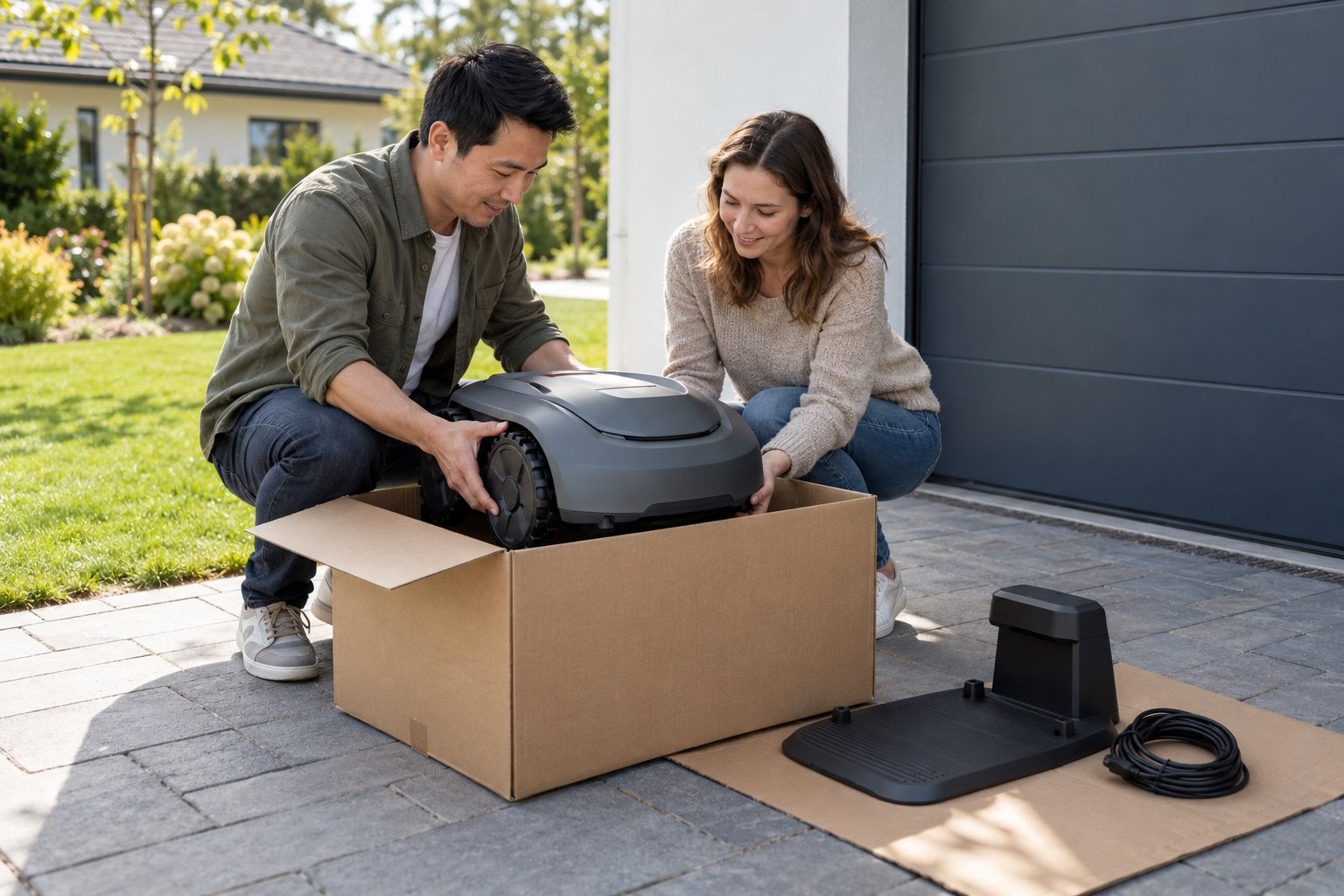 Buying and ownership
Robot Mower Setup: Base Station, Antenna and Mapping
What to settle about power, station placement, antenna sky view and mapping before the box arrives, using exact package lists.
Read the guideEdited
 Buying and ownership
Robot Mower Lawn Capacity: Acres, Square Feet, Per Charge
What a stated capacity does and does not tell you, how we convert square feet to acres, and why per-charge figures are not the same number.
Read the guide Buying and ownership
Robot Mowers for Large Lawns: Beyond the Acre Figure
Zones, passages, per-charge coverage, antenna reach and delivery weight matter as much as the stated capacity when the lawn is half an acre or more.
Read the guideHow we compare and rate the mowers is explained on How we rate. The rest of the team: Our editors.